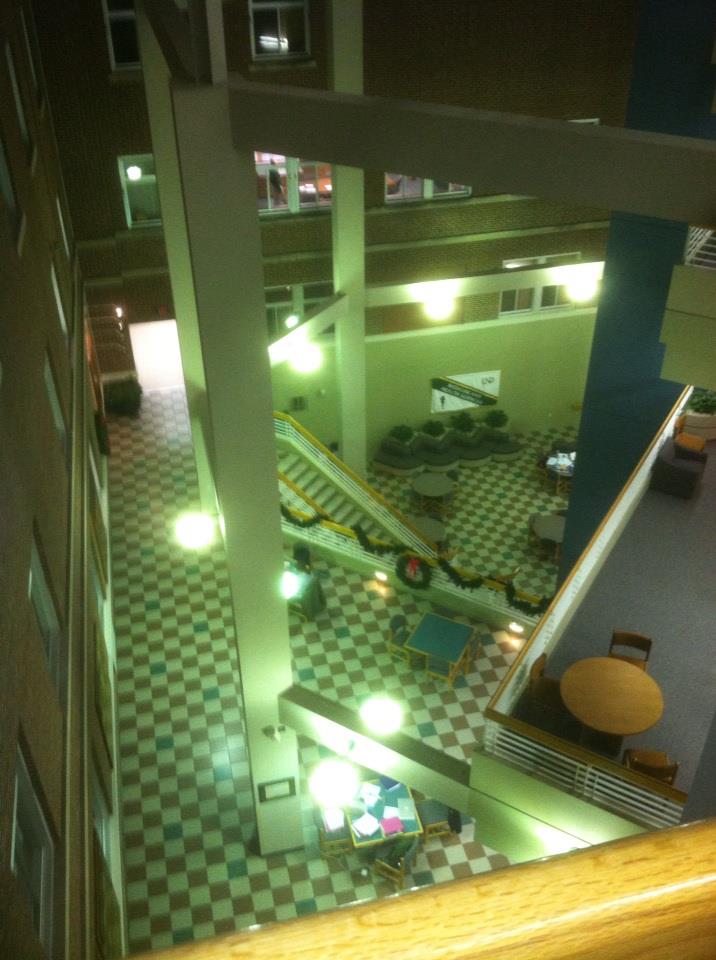
I’m an Associate Professor at the University of North Dakota School of Medicine and Health Sciences, and it’s an exciting time for us here in medical education. In a little less than 2 years’ time, we’ll be moving into a new health sciences school, which was a long time coming. No doubt, this is a once in a lifetime opportunity, and I’m grateful to have this chance to be part of an advancement of knowledge and education.
Currently, we’re in a building that is actually the old St. Michael’s hospital, which was constructed on its present site on North Columbia Road in 1951. It replaced the original St. Michael’s, built in 1907 which is still standing right along the Greenway trail facing the Red River of the North at the Kennedy Bridge (U.S. Highway 2, the “high-line”), which links North Dakota and Minnesota. It’s interesting, as we are a medical school that doesn’t have a University Hospital or Clinic system, yet we are in this old hospital, a building that has been almost solely used for classroom education, research, and administration- not for patient care since it became a medical school. Our new building will have many design elements that will foster communication and “face time” interaction. If you were to design a building that caused people to be isolated, it would be our current one; of course, a patient care environment would require privacy and places to perform procedures. This was a very modern facility when opened, leaving behind the then-common practice of having large “wards”, where many patients would be in a large room separated by stand up cloth room dividers. The original medical school was founded in 1905, and has been in the current location since the early 1990’s after decades in a building called “Old South”.
As you walk through the Columbia Road building, it’s very apparent which parts of the building are relatively unchanged from the 1950’s, and other areas that are much newer. When I walk through it, especially at night when there are few others, if any, around, you can hear it breathing; the energy of all the souls who were born here and those who passed away after a long full life or perhaps prematurely or unexpectedly. I think of family members or friends pacing these same hallways waiting to hear news on their loved ones. As well, there are pictures of every student who graduated from here to go on to their careers, some now long since gone. Faculty portraits also garnish some areas; I can still hear some of their voices from when some were my mentors all those years ago. It’s living history.
We have a chance to continue to bring all of this important history forward to our students and all of North Dakota in the coming years. Hopefully, a future faculty member or student will pause late at night considering the relics of the past and be mindful of what came before, enriching their own paths to find knowledge, old and new, ever forward in service.
 Standing At The Gates Of The West